
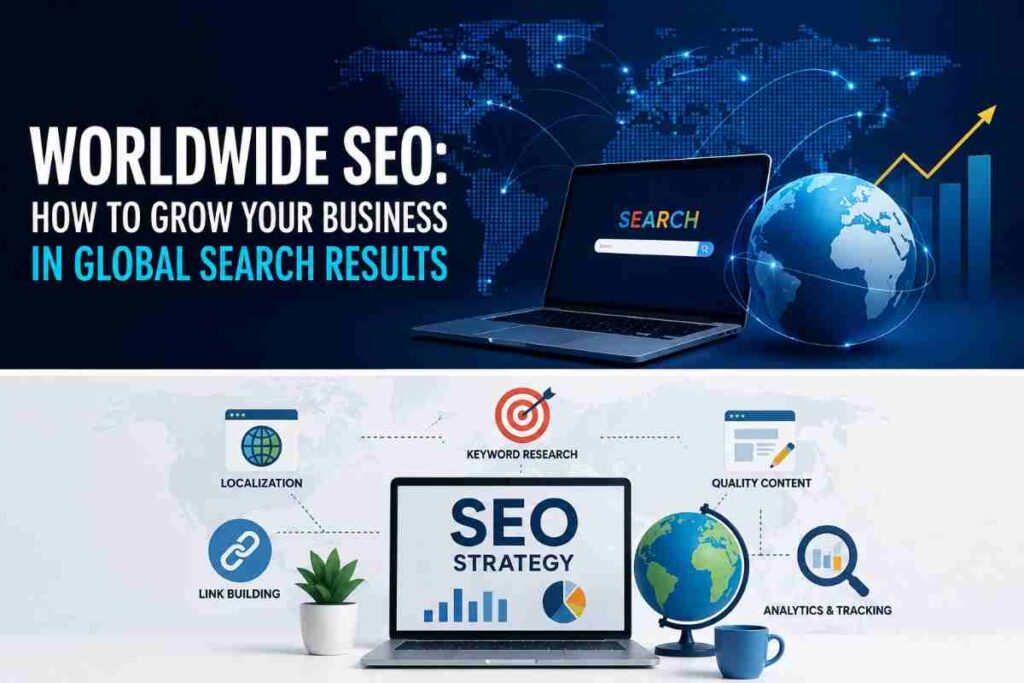
Expanding a business beyond its home market can unlock new customers, traffic, and revenue—but simply translating a website or adding a few international pages is not enough. Worldwide SEO is a broader strategy that helps businesses build search visibility across multiple countries, languages, and markets.
A successful worldwide SEO strategy combines technical SEO, localized content, international keyword research, appropriate website architecture, country-specific link building, and a strong understanding of local search intent. Current international SEO guidance also emphasizes that localization is more than translation and that regional authority matters when competing in different markets.
For businesses looking to expand globally, the objective is simple: show the right page to the right audience in the right market at the right time.
In this guide, we’ll explain how worldwide SEO works, why it matters, what strategies you should use, and how professional SEO and link building services can support international growth.
What Is Worldwide SEO?
Worldwide SEO is the process of optimizing a website so it can attract organic search traffic from users in different countries and regions.
Traditional SEO may focus on ranking for keywords in one country. Worldwide SEO takes a broader approach by considering:
- Different countries
- Different languages
- Local search behavior
- Country-specific keywords
- Local competitors
- International website architecture
- Regional backlinks
- Localized content
- Technical SEO
- User experience
- Search intent
For example, a company may want to target customers in the United States, United Kingdom, Canada, Australia, Germany, France, Spain, Italy, and other markets.
The company cannot simply publish the same English page and expect identical performance everywhere. Search behavior, terminology, competition, purchasing habits, and language can differ significantly between markets.
International SEO guidance consistently recommends researching individual markets and adapting content and technical signals accordingly.
Why Worldwide SEO Matters for Global Businesses
The internet has made it possible for businesses of almost any size to reach customers internationally.
However, having a website that can technically be accessed from another country does not mean that the website will rank there.
This is where worldwide SEO becomes important.
A well-planned global SEO strategy can help you:
Increase International Organic Traffic
Instead of depending entirely on traffic from one country, you can build visibility across several markets.
This creates additional opportunities to attract potential customers who are already searching for your products or services.
Reach New Customers
A website ranking well in one market may have significant growth opportunities in another.
For example, a company performing well in the UK might discover valuable opportunities in Canada, Australia, or the United States.
Diversify Your Traffic Sources
Relying on one market can create unnecessary risk.
Developing organic visibility in multiple countries can diversify your acquisition channels and reduce dependence on a single market.
Build International Brand Awareness
Ranking consistently for relevant searches in different countries can increase brand recognition.
Over time, users may become familiar with your brand before they are ready to purchase.
Generate More Qualified Leads
Worldwide SEO is not just about getting more visitors.
The objective is to attract relevant visitors who have genuine interest in your products or services.
That means targeting the right keywords, search intent, locations, and content topics.
Worldwide SEO vs. Local SEO
Worldwide SEO and local SEO are related, but they have different objectives.
Local SEO generally focuses on visibility within a specific geographical area, such as:
- London
- New York
- Toronto
- Dubai
- Manchester
Worldwide SEO focuses on broader international markets and may involve multiple countries and languages.
For example:
Local SEO: “SEO agency in London”
Worldwide SEO: “SEO services for international businesses”
A business can use both strategies simultaneously.
For example, an SEO agency could optimize its website for local searches while also creating international landing pages targeting businesses in different countries.
1. Choose Your Target Countries Carefully
One of the biggest mistakes businesses make is trying to target the entire world immediately.
Worldwide SEO does not mean creating pages for every country.
Instead, start by identifying markets with genuine business potential.
Consider:
- Search demand
- Competition
- Revenue potential
- Existing traffic
- Conversion rates
- Customer demand
- Language requirements
- Shipping or service availability
- Local regulations
- Existing brand awareness
Current international SEO recommendations emphasize evaluating market opportunity and operational readiness rather than choosing markets based purely on estimated traffic.
For example, if your business already receives organic traffic from Germany, that could be a stronger starting point than launching pages for a completely unrelated market.
Start With Your Data
Use tools such as Google Search Console and SEO platforms to identify:
- Countries already sending traffic
- Countries generating impressions
- International keyword opportunities
- Competitor visibility
- Pages receiving international visitors
Then prioritize the markets with the strongest combination of demand and business potential.
2. Conduct Country-Specific Keyword Research
Keyword research is one of the most important parts of worldwide SEO.
A keyword that performs well in one country may not perform equally well somewhere else.
For example, users in the UK and US may use different terminology for the same product or service.
Therefore, international keyword research should consider:
- Language
- Country
- Search volume
- Search intent
- Local terminology
- Competition
- Commercial intent
- SERP results
Avoid simply translating your existing keyword list.
Instead, research what people actually search for in each market.
For multilingual websites, this distinction becomes even more important. International SEO resources recommend performing keyword research specifically for each target market rather than simply translating keywords from the original language.
3. Create Localized Content
Translation and localization are not the same thing.
Translation changes words from one language to another.
Localization adapts the entire experience to a specific audience.
This can include:
- Language
- Currency
- Examples
- Measurements
- Pricing
- Cultural references
- Product terminology
- Calls to action
- Customer expectations
- Local search intent
For example, an English page created for the US market may not need to be identical to an English page targeting the UK.
Even when the language is the same, users may use different terminology and have different expectations.
Modern international SEO guidance strongly emphasizes localization rather than publishing large volumes of automatically translated content.
4. Choose the Right International URL Structure
Your website architecture plays an important role in worldwide SEO.
There are three common approaches.
Country-Code Domains
Examples:
example.de
example.fr
example.co.uk
Country-code top-level domains provide a clear geographic signal but can require separate authority-building and management.
Subdomains
Examples:
de.example.com
fr.example.com
This approach can work for organizations that need greater separation between regional operations.
Subdirectories
Examples:
example.com/de/
example.com/fr/
For many businesses, subdirectories can be easier to manage because international content remains within the main domain.
There is no single URL structure that is perfect for every business. The right option depends on your organization, resources, market strategy, and long-term website architecture.
5. Implement Hreflang Correctly
Hreflang helps search engines understand relationships between localized versions of pages.
For example, you may have:
- English US
- English UK
- French France
- German Germany
Hreflang can help indicate which version is intended for which language or regional audience.
However, hreflang is not a replacement for localization.
Your pages still need:
- Unique and useful content
- Correct URLs
- Proper canonicals
- Crawlability
- Indexability
- Strong internal linking
International SEO resources recommend reciprocal hreflang relationships between equivalent pages and careful validation of implementation.
6. Build Country-Specific Backlinks
One of the most important elements of worldwide SEO is international link building.
A backlink from a relevant and authoritative website can support your SEO strategy, but when targeting different countries, relevance matters.
For example, if you want to rank in Germany, acquiring relevant links from German websites can provide stronger market-specific context than building every backlink from unrelated websites in another country.
This is why international SEO strategies often include region-specific link building and digital PR.
A worldwide link building campaign can include:
- Guest posts
- Niche edits
- Contextual backlinks
- Digital PR
- Editorial placements
- Industry publications
- Local publications
- Relevant directories
- Resource page links
- Brand mentions
The goal should not be to acquire as many links as possible.
Instead, focus on relevance, authority, editorial quality, and natural placement.
7. Use Guest Posting for International SEO
Guest posting can be an effective part of a worldwide SEO campaign when placements are relevant and editorially appropriate.
For example, a business targeting the US could publish useful content on relevant US publications.
A company targeting multiple markets could develop separate outreach campaigns for:
- USA
- UK
- Canada
- Australia
- Germany
- France
- Spain
- Italy
- Netherlands
- Other target markets
The content should be genuinely useful to the publication’s audience.
Instead of publishing the same article everywhere, create market-relevant content based on the publication, audience, and topic.
This can help build:
- Referral traffic
- Brand awareness
- Authority
- Relevant backlinks
- Market-specific visibility
8. Use Niche Edits and Contextual Links Carefully
Niche edits, also known as link insertions, can complement guest posting.
A contextual backlink placed within an already relevant piece of content can provide a useful connection between the source website and your target page.
However, relevance should remain the priority.
A technology website linking to a relevant technology resource is generally more logical than forcing a completely unrelated link into an article.
For international campaigns, you can also prioritize websites based on:
- Country
- Language
- Niche
- Domain authority
- Organic traffic
- Relevance
- Editorial quality
This makes link acquisition more strategic rather than simply focusing on the number of backlinks.
9. Use Digital PR to Build Global Authority
Digital PR can support worldwide SEO by helping businesses earn attention and links from authoritative publications.
A digital PR campaign might involve:
- Original research
- Industry statistics
- Expert commentary
- Surveys
- Data studies
- Newsworthy reports
- Expert interviews
- Unique insights
For international campaigns, PR can also be localized.
For example, a business could create one research report and then develop different stories around the data for different markets.
This can increase the chances of earning relevant international media coverage.
10. Optimize Technical SEO for Global Audiences
Technical SEO becomes more complicated as your website grows internationally.
Important areas include:
Crawlability
Search engines need to discover your international pages efficiently.
Indexation
Only useful, indexable pages should be included in your international strategy.
Canonical Tags
Localized versions should use appropriate canonical signals.
Hreflang
Make sure language and regional alternatives are correctly implemented.
Internal Linking
Connect relevant pages within the same language or market where appropriate.
Website Speed
International visitors may access your website from locations far from your server.
A CDN can help deliver website resources more efficiently to users in different regions.
Mobile Experience
Your international pages should work smoothly across mobile devices.
11. Build Internal Links Between Relevant Pages
Internal linking is often overlooked during international expansion.
Suppose you have:
example.com/us/seo-services/
and
example.com/uk/seo-services/
You should create a logical architecture that allows users and search engines to understand the relationships between your pages.
At the same time, avoid randomly sending users from one language version to another.
International SEO guidance recommends keeping internal links relevant to the language and market experience wherever possible.
12. Track SEO Performance by Country
A worldwide SEO campaign should never be measured only at the domain level.
Track performance by:
- Country
- Language
- Landing page
- Keyword
- Organic traffic
- Impressions
- Click-through rate
- Conversions
- Revenue
- Backlinks
- Indexation
For example:
| Market | Organic Traffic | Conversions | Priority |
| USA | High | High | Expand |
| UK | High | Medium | Optimize |
| Canada | Medium | High | Expand |
| Germany | Medium | Medium | Test |
| France | Low | Low | Research |
This type of analysis helps you decide where to invest additional resources.
Common Worldwide SEO Mistakes
Even well-established businesses can make mistakes when expanding internationally.
Creating Hundreds of Translated Pages
More pages do not automatically mean more rankings.
Create pages where there is genuine search demand and business value.
Ignoring Hreflang
Incorrect hreflang implementation can make it harder for search engines to understand your regional versions.
Using the Same Keywords Everywhere
Keyword behavior varies between markets.
Research each market individually.
Building Only Generic Backlinks
If you’re targeting several countries, consider developing relevant authority in each market.
Automatically Redirecting Users
Automatic IP-based redirects can create problems for users and search engines. International SEO guidance recommends stable locale-specific URLs rather than relying on automatic redirects as the primary mechanism.
Ignoring Local Search Intent
A translated page may technically use the correct language but still fail to satisfy what users in that market actually want.
How Professional Worldwide SEO Services Can Help
Managing international SEO internally can become difficult as the number of markets increases.
A professional SEO partner can help with:
International Keyword Research
Identify profitable keywords across different countries and languages.
Technical SEO
Audit:
- Hreflang
- Canonicals
- Indexation
- Site architecture
- Internal links
- Page speed
- Crawlability
Content Strategy
Develop market-specific content based on search demand and user intent.
Guest Posting
Secure relevant editorial placements on websites within your target markets.
Link Building
Build a diverse and relevant backlink profile across multiple industries and countries.
Niche Edits
Find relevant existing content where contextual link placements make sense.
Digital PR
Develop campaigns designed to earn authority, mentions, and editorial links.
White Label SEO
Agencies can also outsource parts of their link building and SEO campaigns to a white-label provider while maintaining their own client relationships and branding.
If you’re an agency looking to scale your SEO fulfillment, BacklinksWebsites can be positioned as part of that workflow, particularly for guest posting and link-building campaigns.
Why a Scalable Link Building Strategy Matters
International SEO is not a one-time project.
As you enter new markets, your competitors are also building authority.
A scalable link building strategy allows you to consistently develop your website’s authority without sacrificing relevance.
For example, instead of building 500 unrelated links, you might create a structured campaign:
Phase 1: Build authority in your primary market.
Phase 2: Expand into two or three high-potential countries.
Phase 3: Develop local content and backlinks.
Phase 4: Analyze rankings and conversions.
Phase 5: Scale successful markets.
This approach is generally more sustainable than launching dozens of markets simultaneously.
How to Create a Worldwide SEO Strategy
A practical worldwide SEO campaign can follow these steps:
Step 1: Analyze Your Current Website
Review your existing rankings, traffic, backlinks, technical SEO, and international visitors.
Step 2: Identify High-Potential Markets
Use search demand, competition, conversions, and business potential.
Step 3: Research Local Keywords
Build separate keyword lists for each market.
Step 4: Create the Correct Architecture
Choose subdirectories, subdomains, or country-code domains based on your requirements.
Step 5: Localize Your Content
Adapt content to each market rather than simply translating it.
Step 6: Fix Technical SEO
Implement hreflang, canonicals, internal links, structured URLs, and strong page performance.
Step 7: Build Local Authority
Use guest posts, niche edits, digital PR, and other relevant link-building strategies.
Step 8: Monitor Results
Track organic traffic, rankings, conversions, and backlinks by country.
Step 9: Scale What Works
Invest more heavily in markets producing strong business results.
The Future of Worldwide SEO
Worldwide SEO is also becoming more closely connected with AI-powered search.
Search engines and AI systems increasingly rely on information that can be retrieved, understood, and associated with the correct entities and markets. Recent discussions around international SEO highlight the importance of maintaining accurate, market-specific information across both traditional search and AI-driven search experiences.
That means businesses should focus on creating information that is:
- Accurate
- Useful
- Well structured
- Locally relevant
- Easy to understand
- Supported by credible sources
- Consistent across the web
Rather than trying to optimize exclusively for one search engine feature, businesses should build a strong overall digital presence.
Final Thoughts
Worldwide SEO is more than translating a website into different languages.
It is a complete strategy for building visibility, relevance, authority, and trust across international markets.
The strongest campaigns combine:
- International keyword research
- Localized content
- Technical SEO
- Hreflang
- Strong website architecture
- Country-specific link building
- Guest posting
- Niche edits
- Digital PR
- Performance tracking
Businesses that approach international SEO strategically can create a scalable source of organic traffic and leads across multiple markets.
If your goal is to expand your website internationally, start with a few high-potential markets rather than trying to target every country at once. Build the right technical foundation, create genuinely localized content, and develop relevant authority through a consistent link-building strategy.
Ready to grow your website’s visibility worldwide? A strategic combination of SEO, guest posting, white-label link building, niche edits, and digital PR can help you build a stronger international search presence while keeping your campaign focused on relevant markets and measurable business results.